

Information Typing: The Missing Layer in AI-Ready Content
Structured Content & AI-Ready Knowledge
AI Doesn’t Just Need Your Content. It Needs to Understand What the Content Is For.
Why information typing, a foundational principle of structured authoring, is becoming essential to the next generation of enterprise AI.
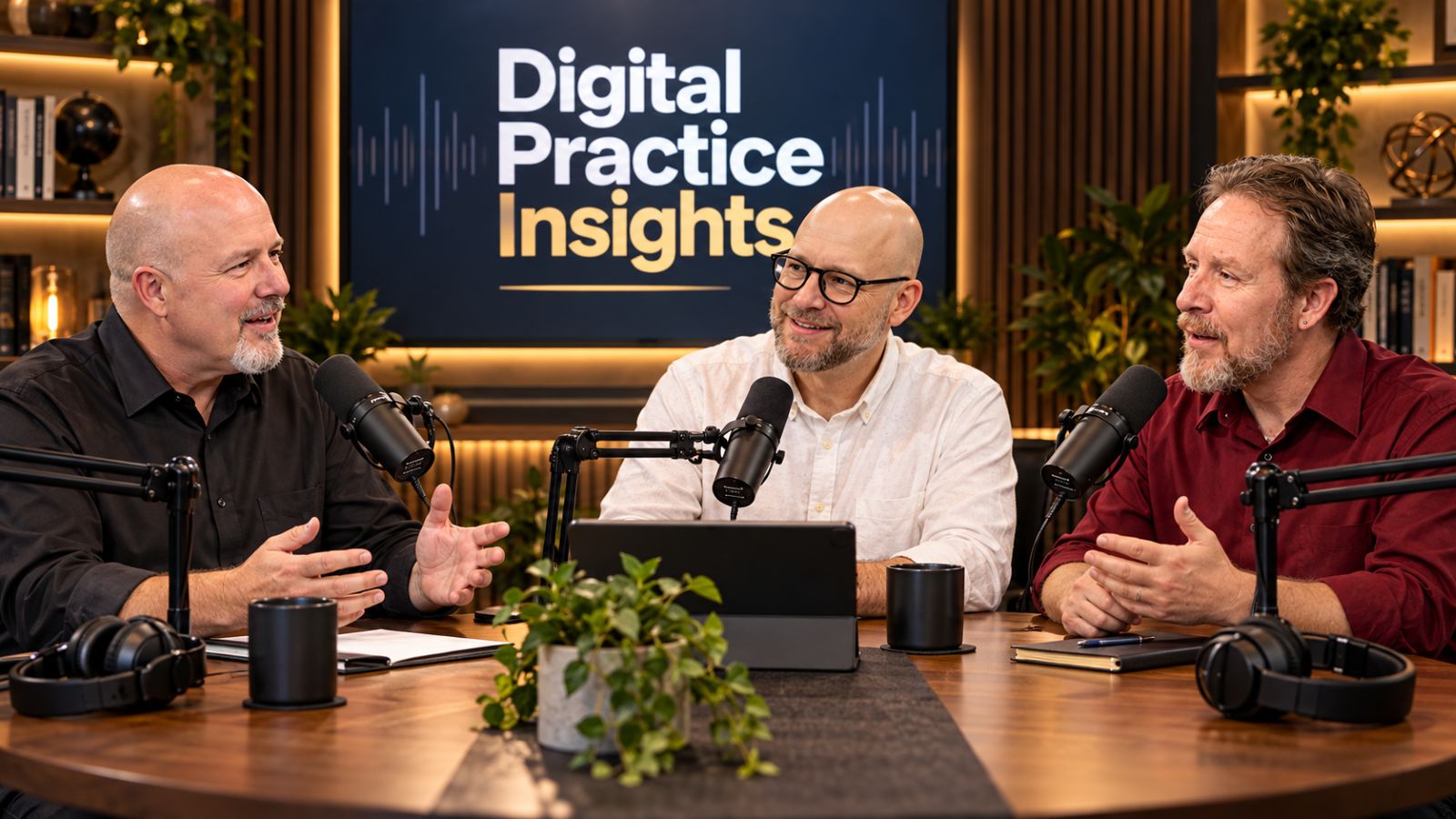
Hear the real conversation →
Featured Conversation · Digital Practice Insights
Information Typing in DITA: Rob Hanna and Lance Cummings
Precision Content CEO Rob Hanna joins Dr. Lance Cummings, professor of professional writing at the University of North Carolina Wilmington, for a conversation with host Larry Swanson about information typing, human cognition, structured authoring, and what these disciplines mean for AI.
Episode 215 · June 28, 2026
Enterprises are investing heavily in AI. They are building retrieval-augmented generation (RAG) systems, deploying copilots, experimenting with autonomous agents, and connecting increasingly sophisticated models to their corporate knowledge.
But there’s a fundamental problem hiding beneath all that technology.
Most enterprise content was never designed to communicate what kind of knowledge it contains, what that knowledge is intended to accomplish, or how it should be used.
That distinction matters more than ever. In a recent episode of Digital Practice Insights, Rob Hanna and Lance Cummings explored a principle that’s been central to structured authoring for decades: information typing.
Their discussion points to an important shift. Information typing offers a method for designing knowledge that people can understand and that AI systems can interpret with greater precision.
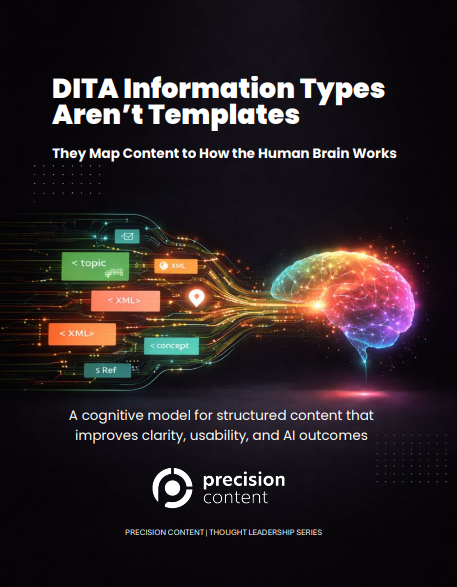
The white paper behind the conversation
Information types are not templates.
Go deeper into the ideas that anchor Rob, Lance, and Larry’s discussion. Explore information typing as a foundation for content designed around what people and AI need to understand, decide, and do.
PDF · Opens in a new tab
Information typing: The missing intelligence in enterprise content
Most organizations classify content by its format or where it lives: documents, PDFs, knowledge articles, web pages, manuals, and procedures.
Information typing asks a different question:
What is this information supposed to help someone understand, decide, or do?
The distinction is fundamental. Information has different functions, and those functions call for different structures.
DITA established three foundational information types: concept, task, and reference. Precision Content’s methodology extends this model with principle and process, helping teams structure a wider range of enterprise knowledge.
01 / UNDERSTAND
Concept
Explains what something is, how it works, and why it matters.
02 / ACT
Task
Describes the steps required to complete a specific action.
03 / LOOK UP
Reference
Provides facts, specifications, definitions, and other information for quick retrieval.
04 / GOVERN
Principle
Establishes rules, policies, conditions, and constraints that guide decisions.
05 / COORDINATE
Process
Explains how activities, roles, decisions, and handoffs work together to achieve an outcome.
These are more than document templates. They are ways of organizing knowledge according to its intended function.
For human readers, this reduces the effort required to interpret information. For AI, it can provide clearer signals about what a piece of information represents and how it relates to a question or action.
From AI-ready content to agent-ready knowledge
Much of today’s enterprise AI strategy focuses on helping an assistant find and summarize information.
But the next generation of AI systems will increasingly be expected to do more than answer questions. Agents will need to interpret situations, evaluate conditions, follow procedures, and initiate actions within defined boundaries.
Consider a financial services organization handling a disputed transaction.
An AI assistant might be asked, “How do I dispute a transaction?” An agent, however, could eventually be expected to determine eligibility, identify applicable policies, select the correct workflow, and escalate exceptions.
Answer-first content
What should I know?
Explains policies and procedures so a user or chatbot can retrieve an answer.
Agent-ready knowledge
What can I do, and under what conditions?
Makes rules, constraints, decisions, actions, and process relationships explicit.
This is where the distinction between information types becomes particularly valuable.
A task describes an action. A principle establishes the rules that govern it. A process defines how actions and decisions fit together.
Information typing alone does not make an AI agent reliable or authorize it to act. Systems still require permissions, validation, orchestration, and safeguards. But well-structured knowledge can give those systems a more intelligible foundation to work from.
Why structure alone isn’t enough
There’s an important misconception in the market: that putting content into XML, DITA, or a component content management system automatically makes it AI-ready.
It doesn’t.
A structured document can still contain vague instructions, duplicated explanations, buried conditions, inconsistent terminology, and ambiguous rules.
The real discipline begins before a writer selects a DITA element or creates a topic. It begins by asking what the information needs to accomplish and designing the content accordingly.
That is why Precision Content emphasizes writing for intent. Content should be explicit, consistently structured, and designed for how it will be used.
DITA and a CCMS can provide powerful technical capabilities for reuse, governance, metadata, and publishing. But the quality of the underlying knowledge still depends on the information model and the standards applied by its authors.
Early research points to a significant opportunity
One of the most interesting parts of the podcast is Lance Cummings’ exploration of how structured content influences generative AI performance.
His exploratory classroom work with AI chatbots and structured knowledge suggests that how source content is organized can meaningfully affect how a retrieval-based system responds.
This is an emerging area of inquiry, not yet a definitive scientific claim. The experiments discussed are exploratory and do not establish a universal performance improvement.
Nevertheless, the implication is worth taking seriously.
Better AI performance may not always require a better model. Sometimes it requires better-structured knowledge.
Organizations evaluating RAG and enterprise AI should therefore test not just different models, embeddings, and retrieval techniques, but also the design and quality of the source information itself.
The next competitive advantage is knowledge engineering
For years, enterprise content initiatives have been measured primarily in terms of publishing efficiency: creating content faster, translating it more easily, and reusing it across multiple outputs.
Those benefits still matter. But AI introduces a much larger strategic opportunity.
What if enterprise knowledge could be designed as a governed, maintainable infrastructure that supports employees, customers, applications, and autonomous systems?
That requires a connected set of disciplines: content strategy, information architecture, information typing, structured authoring, governance, metadata, and the technology needed to manage content at scale.
The Precision Content Approach
From content debt to trusted knowledge infrastructure
01 · DIAGNOSE
DocIntel Analyzer™
Identify content quality issues, structural weaknesses, and knowledge debt.
02 · TRANSFORM
NOVA™ Content Refactoring
Restructure legacy content into more consistent, reusable knowledge components.
03 · OPERATIONALIZE
Structured Authoring & CCMS
Establish the standards, governance, workflows, and platforms to sustain knowledge quality.
The objective is to create knowledge that is more reliable, easier to maintain, reusable across experiences, and better suited to intelligent systems.
The future belongs to content designed for understanding and action
Information typing is not a new invention. Its roots stretch back decades, long before DITA, RAG, large language models, or agentic AI.
What has changed is the scale of the opportunity.
We are moving into an environment where enterprise knowledge must serve both people and machines. That makes the function of information, not simply its format, a critical design consideration.
For technical writers, content strategists, knowledge managers, and AI leaders, the challenge is to stop thinking of documentation as a collection of files and start treating it as an engineered knowledge asset.
Your content is AI infrastructure. The quality of that infrastructure starts with how knowledge is designed.
Go Deeper
Hear the full conversation
Listen to Rob Hanna and Dr. Lance Cummings discuss the origins of information typing, its role in DITA, and why these principles matter to the future of AI-driven knowledge.
Precision Content
Is your knowledge ready for AI?
Before investing more in AI technology, understand whether the content behind it is clear, consistent, structured, and trustworthy. Precision Content helps organizations diagnose knowledge debt, redesign content, and build the foundation for reliable AI experiences.
Related Reading
Case StudyAgent-Ready Documentation in Financial Services →
Case StudyHow a Global Bank Improved Answer Speed, Accuracy, and Confidence →