
Please contact us to set up your account with Precision Content

Explore conference presentations, webinars, and YouTube videos on structured content, microcontent, DITA, content operations, metadata, omnichannel delivery, and AI-ready knowledge.
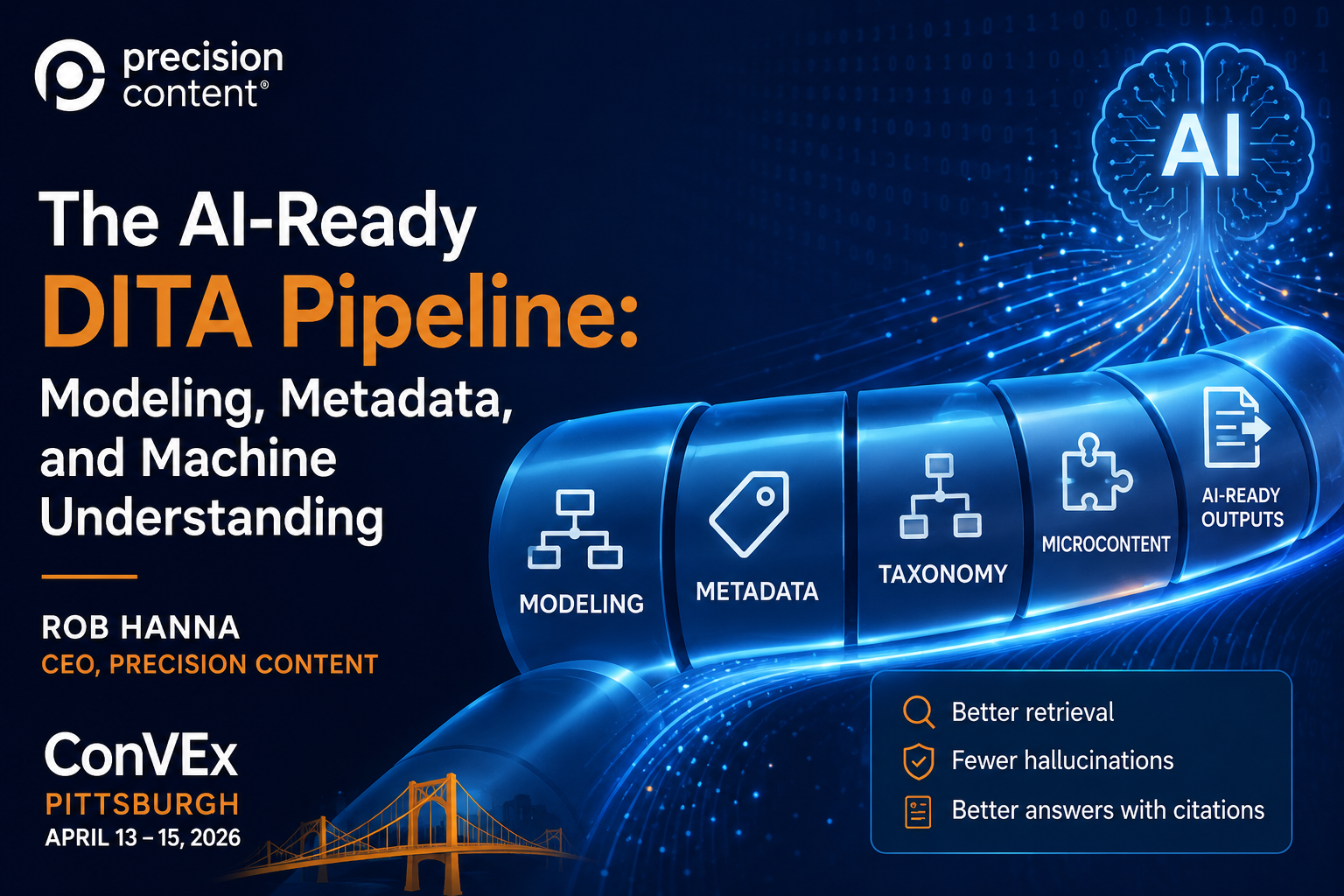
Generative AI is changing what content teams need from DITA. This presentation explains how modeling, metadata, taxonomy, microcontent, and output transformation can make structured content easier for AI systems to retrieve, rank, cite, and use. It is worth reading if you are preparing technical content for RAG, agentic retrieval, or AI-assisted delivery.
Presented by Rob Hanna at ConVEx 2026, Pittsburgh, PA.

AI success depends on more than models and tools. This presentation explains why content quality, structure, consistency, and microcontent are essential for trustworthy AI performance. It shows how to measure content effectiveness for both people and machines, and why organizations need better content foundations before they can rely on generative AI at scale.
Presented by Rob Hanna at ConVEx 2025, San Jose, CA.
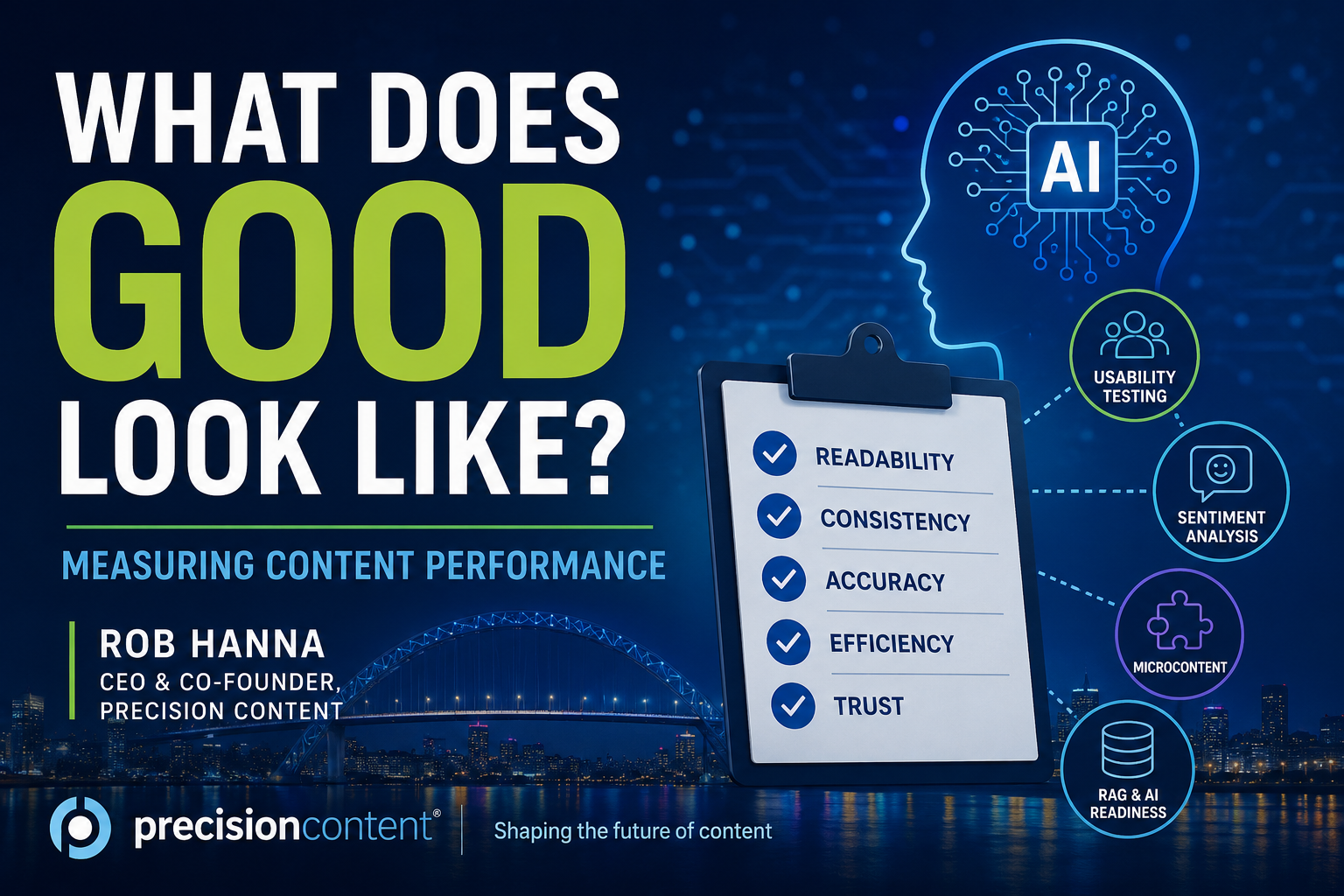
AI has raised the stakes for content quality. This conference presentation explains how organizations can define what “good” content looks like, measure human performance, and prepare content for machine use. Rob Hanna explores readability, structure, usability testing, sentiment analysis, RAG, and microcontent, showing how better content helps people find answers faster, make fewer errors, and trust information more. It is worth reading for anyone building content that must perform for both humans and AI.
Presented by Rob Hanna at LavaCon 2024, Portland, OR.
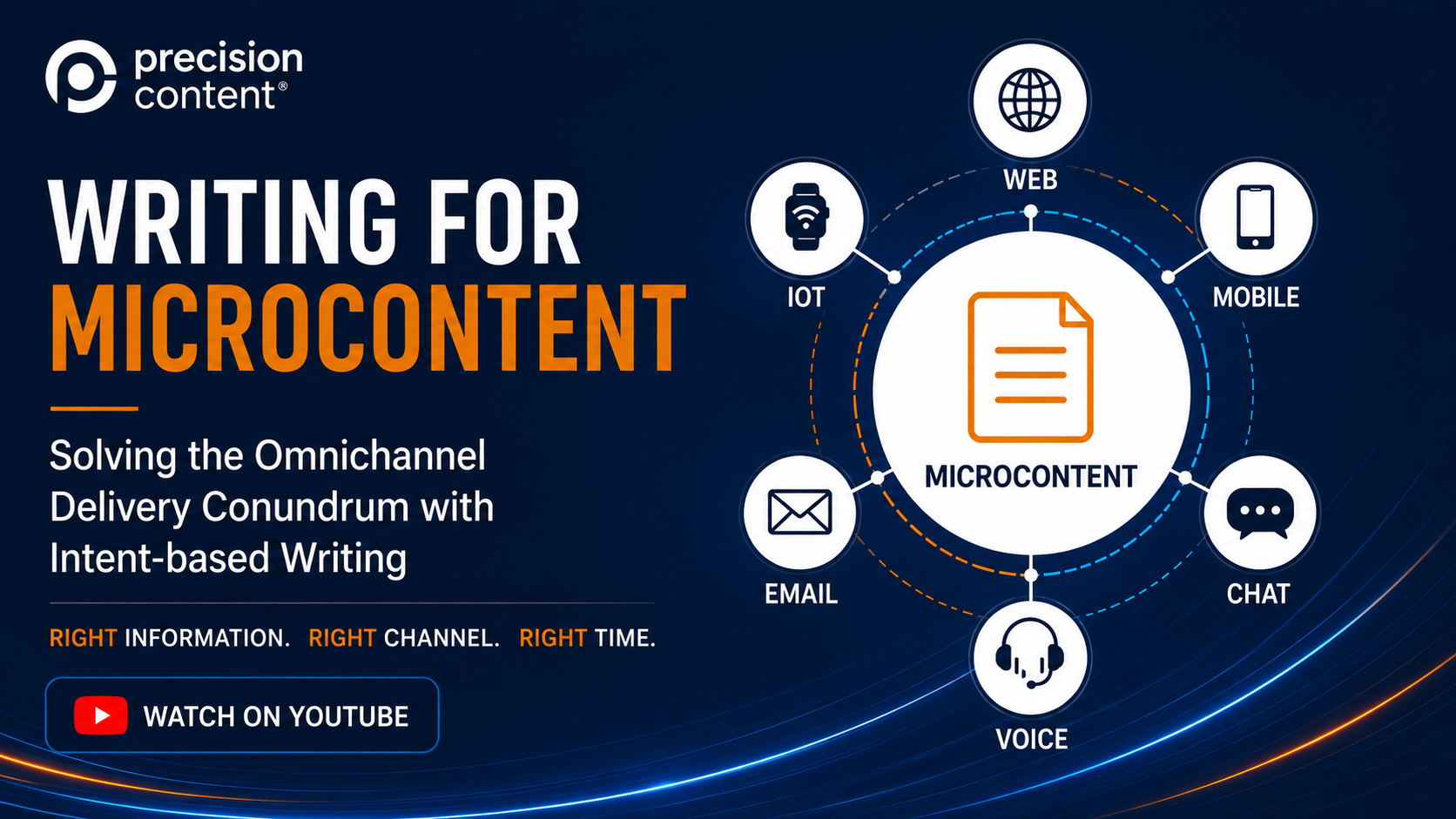
Omnichannel expectations are changing how customers find and use information. This presentation explains why traditional web writing does not work across modern channels such as websites, mobile apps, chat, voice, email, and IoT. Rob Hanna shows how intent-based writing and microcontent help organizations deliver the right information, in the right format, at the right time, across every customer touchpoint.
Presented by Mike Rowlinson, Co-creator of Precision Content’s writer training.

As content volumes grow, even well-managed DITA assets can become difficult for authors to find, reuse, and govern. In this Adobe DITAWORLD session, Susanna Carlisi explains how Adobe Experience Manager metadata can improve findability, reduce rework, and help teams unlock more value from their CCMS.
The presentation is worth watching if your content creators struggle to locate the right information, if reuse is inconsistent, or if your folder and metadata strategy needs to support better governance, automation, and personalization.
Presented by Susanna Carlisi, Senior Information Architect at Precision Content, at Adobe DITAWORLD 2025.

iiRDS is gaining adoption as the metadata standard for technical documentation. This metadata standard is helping businesses to build out their metadata, taxonomies, and ontologies in an organized manner.
This presentation will examine what iiRDS is, the business problems it’s designed to solve, and show a demo of iiRDS applied to a content set.
Audience members will benefit from this presentation by
Presented by Ted Wolff at the Convex 2023 conference on April 18, 2023.
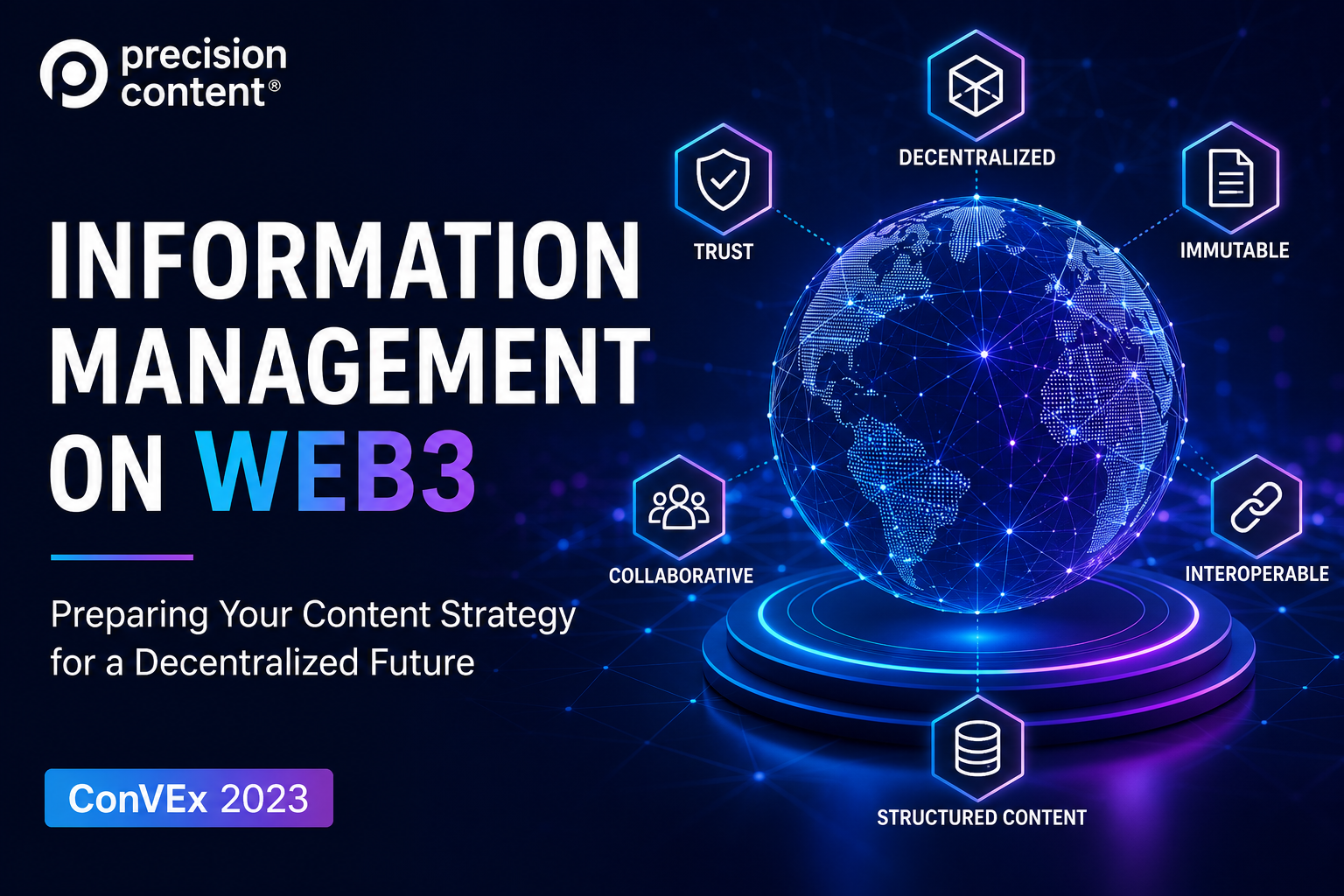
Web3 will supposedly revolutionize our experiences online, but how will it change our information management practices? This presentation will catch the audience up with the latest conversations in AI-powered content strategy, NFT metadata standards, and distributed alternatives to HTTP such as the InterPlanetary File System, with a focus on what has changed since the recent industry downturn.
This presentation will illuminate the aspects of Web3 technologies that are relevant to an audience of information architects and content professionals. Eschewing the hype that often characterizes discussions of Web3, this presentation will give a practical look into the current information management practices on these novel, permissionless, and distributed technologies.
Presented by Josh Anderson at the Convex 2023 conference on April 18, 2023.
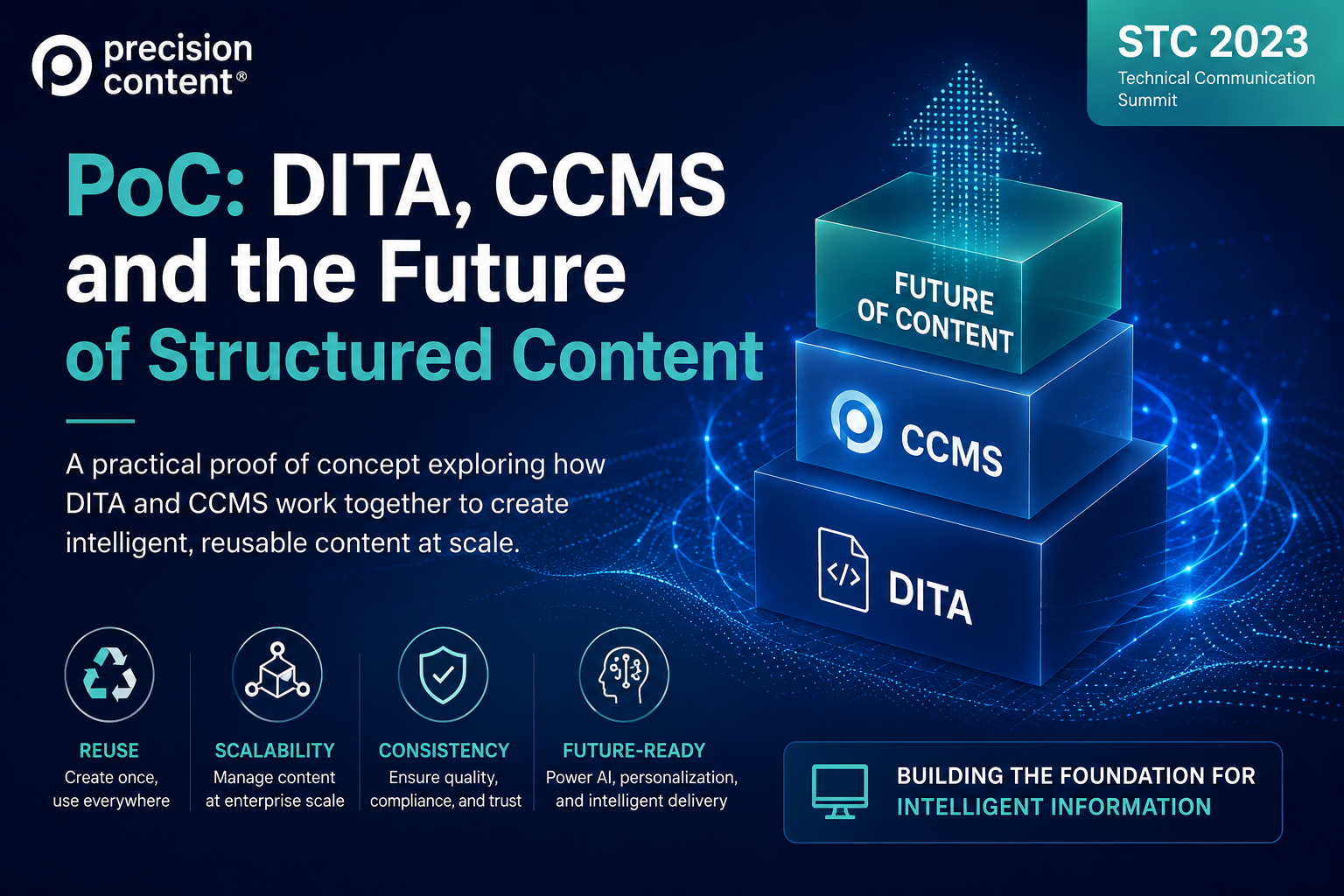
Transitioning from unstructured authoring to structured authoring with DITA is a major investment for an organization. For the transition to be successful, people, processes, tools, and resources need to work in sync. It is surely not for the faint of heart, but it does not have to be a scary process. A well-thought-out proof-of-concept (PoC) project can provide many benefits and insights to ensure the success of your DITA adoption project. The benefits of PoC include providing proof of feasibility and proof of value, reducing risks, getting team and leadership buy-in, and providing rationales to secure funding. This presentation defines the concept of PoC and details the factors you need to take into consideration when conducting a PoC project for DITA and CCMS adoption so that you can reap the full benefits of the PoC project.
The audience will learn
Presented by Peihong Zhu at the STC Summit Conference 2023 conference on May 17, 2023.

On the second day of the Adobe DITAWORLD 2023 conference, Rob Hanna, President and Co-Founder of Precision Content, delivered a visionary keynote. An inspiring journey through the landscape of structured content, the power of DITA and the transformative potential of generative AI. In his keynote, Rob addressed the importance of structured content and why DITA is the undisputed champion in this space. He explained the power of Adobe Experience Manager Guides and showed how you can effectively manage structured content and deliver world-class digital experiences to your customers.
But the journey doesn’t end there! Rob also looked at the horizon and explored the frontiers of generative AI and its potential to transform the content supply chain.
Can what was once just an idea and vision become a tangible, exciting reality? Watch this refreshing journey into the future of content and imagine, and let’s design the next generation of digital experiences together, guided by a pioneer in the field.
Key Takeaways
Presented by Rob Hanna at the Adobe DITAWORLD 2023 on June 14, 2023.

Use microcontent to put your team in the driver’s seat to the next level of content publishing for intelligent chatbots. By now reality has revealed that ChatGPT is not ready to write our product documentation for us. With no control over what the publicly-trained models scrape from our websites and blogs and how it assimilates our documentation with other less-authoritative sources, we’re left to wonder where we go next. If we want reliable bots, we’ll need to train our own models and deploy them to our staff and our customers. Let us show you what we’ve learned so far.
In this session, the audience will learn:
Presented by Rob Hanna and Patrick Baker at the LavaCon 2023 on October 16, 2023.

ContentOps is a creature with many complex parts and intricate connective tissues, which if left unchecked could easily go awry and wreak havoc. To be able to monitor the health of your ContentOps, you need appropriate tools. This presentation will introduce a ContentOps maturity model that can be used as the benchmark to identify gaps in the current state or to prescribe the desired future state of ContentOps.
In this session, the audience will learn:
Presented by Peihong Zhu at the LavaCon 2023 on October 17, 2023.

Many of us are familiar with the history around the invention of the press and its profound effects on western civilization. The invention of the press wasn’t a one-off example of engineering brilliance but rather a convergence of many technological advancements and societal friction. The rates of advancement in information technology since that time have moved at an exponential pace such that we cannot appreciate the more recent impacts to our civilization the same way. This talk aims to put content technology in focus to understand how we got to where we are and where we’re headed in the not-too-distant-future.
Presented by Rob Hanna at the Spectrum 2022 conference on September 12, 2022.
Today’s users are burdened by information overloading. It is no longer a viable option to merely present your content and wait for the audience to find it. Businesses must take the initiative to deliver customized content to where the audiences are on multiple technology platforms. To do so effectively, the content must be taken out of the bounds of document or page and systematically organized in smaller chunks. We call these content chunks microcontent.
To make microcontent truly intelligent and omnichannel ready, in addition to chunking, our content needs to be readable by both machines and humans. We need to rethink how we write our content. In this webinar, I will introduce the concept of microcontent and writing practices that enables microcontent to be reusable, reconfigurable, and adaptable for omnichannel delivery.
The audience will
Presented by Peihong Zhu for the Society for Technical Communication on June 30, 2022.
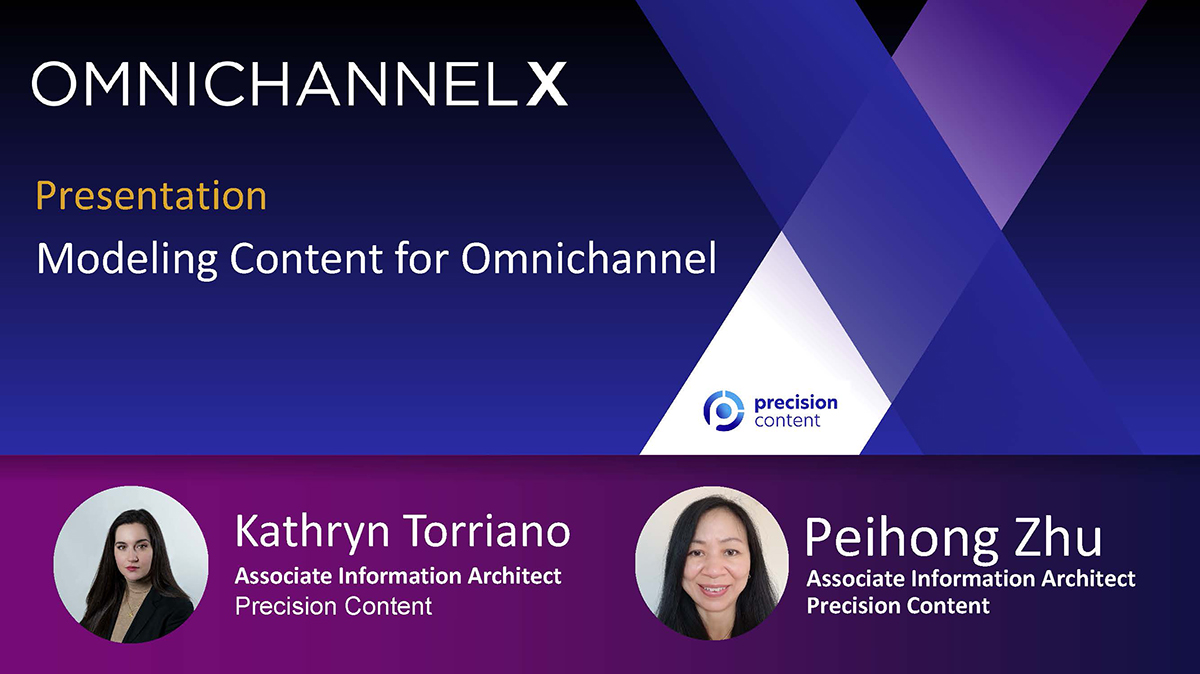
Crack open your content models and unleash the full potential of your content! You can take steps now to prepare your content for any output imaginable (and even some you can’t imagine). To fully leverage the benefits of omnichannel, your content model needs to work for authors, users, and bleeding-edge technology. In this session, we will use a real case study to explore and demonstrate what it means to craft an optimized content model for an orchestrated, seamless, and consistent omnichannel experience. We will show you how to model the right mix of generalization and specialization so that your content can scale to any situation. Your content can have an extended lifecycle and be adaptive to the future, with or without a head for your CMS.
What you’ll learn
Presented by Kathryn Torriano and Peihong Zhu at OmnichannelX 2022 on June 15, 2022.

In this half-day workshop, Precision Content will introduce you to the fundamental practices of human-engineered content: material designed for use by people and machines. Our techniques and methodology are based on the science of human cognition, delving into how and why content works, and how to make it work for you. We teach the techniques to increase usability, reader satisfaction, and retention of the knowledge that you are trying to communicate.
We will show how to systematically tackle existing content and structure it into more easily digestible pieces for your readers’ benefit. You will get hands-on practice using the Precision Content methodology to transform content in real-time. You will see for yourself how to better write and structure your content to align with your user’s needs and the needs for omnichannel delivery.
What you’ll learn
Presented by Sophie Gravel at OmnichannelX 2022 on June 13, 2022.

NFTs aren’t only for trading artwork and meme GIFs; they may one day be central to the way your organization monetizes, distributes, and verifies content. This session will explore how verifiably unique digital assets have the potential to disrupt all aspects of content management.
Viewers will:
Presented by Josh Anderson at the ContentTECH Summit 2022 on June 2, 2022.

Is your company’s content stuck in static document formats like Word or PDF? It’s time for a microcontent migration! At Precision Content, we recently moved an important internal publication out of Word and into microcontent; now our content can be easily updated, reused, or published to whatever output our users need. Come along as I detail how we identified opportunities in our unstructured content, strategically rewrote certain sections to maximize reusability, marked it all up in specialized DITA XML, and thoughtfully planned a microcontent governance strategy to safeguard and extend our newly unlocked business benefits. This education session will be of interest to authors and information architects who want to move beyond the theoretical and see a real-world demonstration of the opportunities enabled by microcontent.
Presented by Josh Anderson at the Society for Technical Communication Summit 2022 on May 18, 2022.
At long last, you’ve developed and implemented what you believe to be an effective content strategy to grow and organize your content, but how do you know if your content is improving? How do you know that your processes are working well? Content maturity models are a means to assess the current state of your structure, architecture, technology, and processes to ensure they are working effectively for your content. This session will examine content maturity models to understand how they can be leveraged to assess your current state and ensure your content is in good health. After all, you can’t manage what you don’t measure.
Presented by Kathryn Torriano at the Society for Technical Communication Summit 2022 on May 16, 2022.
The need for precision with which we author and manage content is growing. Increasingly, we are required to find new ways to get post-sales content into customers’ hands.
The need for more flexible, componentized content delivery grows as the complexity of product solutions increases. Organizations like yours are turning to Content as a Service (CaaS) solutions to serve content via web services for internal and external information systems. As products become subsumed into the Internet of Things (IoT) and Industry 4.0, so will the content needed to support our product components. Even medical, financial, and insurance services are facing these challenges as their services and content are brokered out to consumers and businesses, demanding faster speed and accuracy in our content pipelines.
Join Rob Hanna when he explores in his keynote how to prepare our product content for CaaS solutions with intelligent microcontent. Let’s discuss content operations. We spoke and discussed content strategy for a long decade – now it’s time to discuss content operations. Let’s talk about the operations related to content – and the most important focus is eliminating silos for a reader’s content experience.
Key Discoveries
Presented by Rob Hanna at Adobe DITAWORLD 2022 on May 12, 2022.

In 2019, the National Council on Compensation Insurance (NCCI) began working with Precision Content to transform tens of thousands of pages from DocBook to DITA. The project requirements identified the need for microcontent use cases to support a complex regulatory content lifecycle, automation opportunities, and dynamic delivery needs. This session will walk you through the novel lessons we learned.
Presented by Rob Hanna and Josh Anderson at ConVEx 2022 Tempe on May 2, 2022.
It is no longer an option for businesses to merely present their content and wait for audiences to find it. Businesses must take the initiative to deliver content to multiple platforms. Microcontent provides the solution. In this presentation, we will introduce the concept of microcontent and writing practices that enables microcontent to be reusable, reconfigurable, and adaptable for omnichannel delivery.
Presented by Peihong Zhu and Kathryn Torriano at ConVEx 2022 Tempe on May 2, 2022.
Too many businesses confuse authoring in XML with structured authoring. Simply moving your content from one format or another to XML won’t improve your content. XML will potentially make your content more useful for machine processing but it won’t make it more comprehensible. Moving to structured authoring without the use of XML tools will improve the quality of your content for human consumption without necessarily improving its usefulness for machine processing.
If you do it right, you can achieve both vastly improved usefulness and comprehension of your content when you combine best practices for structured authoring with XML-based tools.
Presented by Rob Hanna for Win With Content on April 27, 2022.

Developing robust content models can never be a once-and-done endeavor where IAs are required to incorporate all aspects into the design prior to authoring. Instead, an iterative approach is needed to allow for incremental improvements not just during setup but long into production. Join Precision Content’s President and Chief Information Architect, Rob Hanna, to explore methods the company uses to refine models and update the content corpus through scheduled refactoring activities.
Presented by Rob Hanna for CIDM on December 1, 2021.
Omnichannel experience is setting the bar for customer expectation and it’s putting new and increasingly complex demands on your business to deliver the right information where your customers need it. Writing for the web is not writing for omnichannel. Preparing your content for emerging technologies requires new approaches to content creation and delivery. It requires a microcontent strategy.
Robust content management technology is certainly part of the solution, and your organization will be tempted to invest in new tools for chatbots and voice. However, before you go ahead and fill yet another content silo with zettabytes of information, instead make enhancements to the content creation programs you already have. Microcontent is the next evolution in structured authoring and will open new channels for your content while improving delivery across existing channels.
Presented by Mike Rowlinson for CIDM on May 19, 2021.

AI-powered cognitive content solutions perform best with content designed to be read by humans and processed by intelligent technologies. Microcontent will open new channels for our content while improving delivery across existing channels. The path to intelligent microcontent is the next step in our journey in structured authoring, but is microcontent *your* solution? Explore and understand the challenges, unknowns, and possibilities with microcontent.
Presented by Joyce Lam and Kathryn Torriano at ConVEx on April 26-28, 2021.

One of the least-explored areas for information architects is the examination of relationships between different types of information. Most often this is left to the devices of the author or the arcane arts of the taxonomist to determine what is related to what. Even if we can manage relationships between topics with some skill, managing the relationships between fragments of microcontent become exponentially more difficult.
This session explores the enterprise content metamodel to understand how information behaves in a larger ecosystem and map out a universal content model across any enterprise.
Presented by Peihong Zhu and Rob Hanna at ConVEx on April 26-28, 2021.

There are companies and technical writing groups that are leaving DITA. While there have always been groups where DITA initiatives failed to take off, we are seeing a new trend where other technology options are coming into play and successful DITA teams are moving away from using the standard. The fact is that DITA is not for everyone, and it is worthwhile to explore where DITA works best, and where it does not.
This session examines industry trends relating to technical writer employment, look at the new challenges facing DITA, and where DITA is still the best fit.
Presented by Keith Schengili-Roberts and Josh Anderson at ConVEx on April 26-28, 2021.
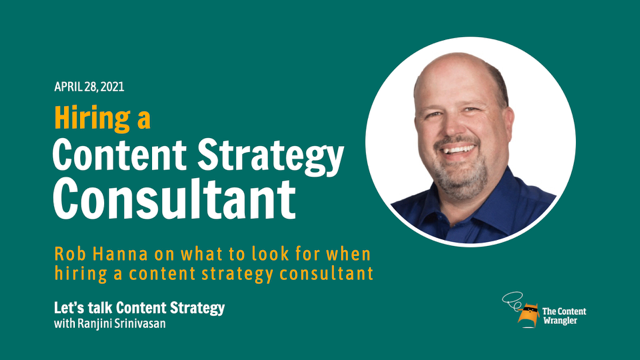
Creating content consistently and cohesively takes time, effort, and budget. Not to mention, the expertise and the specialized skillset. Bringing in a Content Strategy Consultant can alleviate some of the challenges and lay the foundation for a solid content process. Content Strategy is a specialized form of business consulting. In this episode with Rob Hanna, CEO of Precision Content, we will explore how a content strategy consultant works with your organization? Why we need them? What can they support you with, and what can you expect as an outcome?
Presented by Rob Hanna on April 28, 2021.

It’s been 20 years since the Agile manifesto was published, and technical communicators have been trying to find ways to deliver content in a more nimble fashion ever since. Things like bi-weekly Sprints and more frequent standup meetings where everyone is expected to report on their development progress—including content development—ramps up the pressure on technical communicators to find the right tools to enable them to cope. DITA XML is one such tool, with many of its base characteristics, like
…and much more. For an in-depth look at how DITA can assist your technical communications team, watch this video from Precision Content’s Senior Content Strategist Keith Schengili-Roberts who details how and why DITA and Agile go so well together.
Presented by Keith Schengili-Roberts on March 3, 2021.
The authors at Eli Lilly’s Global Medical Information team have transformed from traditional authoring to authoring adaptive components of content. The transformation was approached in a pragmatic way starting from changing writing behaviors, streamlining processes, and implementing a new component authoring technology.
Join us for a case study presentation by Cecil Lee, Content Strategy Advisor at Eli Lilly and Company. You’ll learn how the Global Medical Information team worked together to overcome challenges in transformation. You’ll also discover how the team’s focus on information architecture helped ensure the changes they introduced served the needs of the users, while also providing a positive return on investment to the organization.
This presentation includes:
Cecil Lee joined Eli Lilly Medical Information to manage a global team of medical authors in the diabetes business unit and to implement several global technologies on customer relationships and content management. Previously, Cecil’s work focused on driving innovation by implementing an adaptive content strategy across products, channels, and geographies at Lilly Medical. This effort kickstarted an enterprise content management movement that expanded to other disciplines, including the clinical and marketing organizations. He is currently leading the Content Intelligence strategy for the marketing organization at Lilly.
Presented by Noz Urbina and Cecil Lee on February 16, 2021.

Coffee & Content talks with information development guru, Rob Hanna, about why content creators should focus their efforts on the creation of micro—moments. Hanna will help us understand the role of microcontent — self-contained, atomic pieces of content — in the construction and management of exceptional content experiences.
Presented by Rob Hanna on June 18, 2020.
Join Scott Abel, The Content Wrangler, for a discussion with content strategy gurus Rob Hanna (Precision Content) and Val Swisher (Content Rules) about the findings from the 2020 DITA Satisfaction Survey. Rob and Val will explore several of the trends uncovered in the report and their impact on satisfaction in technical documentation shops that leverage the Darwin Information Typing Architecture to create technical documentation content.
Presented by Rob Hanna and Val Swisher on March 11, 2020.

Consumers don’t search for information, they look for answers. Emerging technologies around conversational interfaces are driving changes to how we create, manage, and deliver the answers they seek. In this presentation, Rob Hanna explores why we must stop attempting to strong-arm a solution — piling new content on top of old content, creating new silos of information upon which we have to wade through and try to keep current. Hanna will discuss why we need to distill our content down to appropriately-sized chunks of information in the form of intelligent microcontent in order to efficiently provide it to others in a manner that enables consumption and reintegration across different business functions in the enterprise.
Presented by Rob Hanna on October 30, 2019.

Content distilled down to appropriate chunks of information in the form of intelligent microcontent take on a new life when they are made available to the enterprise for consumption and reintegration across different business functions. The silos all but disappear when content is rendered to microcontent that is classed, focused, structured, and contextualized. This microcontent then can flow freely across product, marketing, training, and support documentation. Download the presentation to learn more about this transformational opportunity.
Presented by Rob Hanna on October 29, 2019.

Microcontent supports emerging technologies including chatbots and conversational user interfaces. One of the keys to intelligent microcontent is the ability to model content for the intended reader response. DITA goes a long way to modeling for intent, but finer-grained semantics are needed to take us the rest of the way.
Join Scott Abel, The Content Wrangler, and his special guest, Rob Hanna, Chief Information Architect with Precision Content Authoring Services for this free one-hour webinar. This technical session explores the key semantic structures developed by Precision Content to create, manage, and publish with microcontent to both traditional and emerging channels for delivery.
Participants will learn how to architect: typed blocks from DITA sections, process- and principle-type structures, and sub-structures for modeling specific intents.
Presented by Rob Hanna at DITA Virtual Summit on October 15-16, 2019.

In an omnichannel world, people want information they can easily use. To do that, you need content that is designed and structured for user-intent and optimized for today’s technologies. It needs to be microcontent. However, when it comes to creating content, most organizations are stuck with outdated processes and old-school tools. Your organization needs to have the right information flowing to the right people so your business can thrive.
Structuring your content is a critical first step. Structured Authoring Training is a standardized, methodological approach to content creation based on decades of research into how the human brain reads and understands information and modern content creation best-practices.
Join Scott Abel and his special guest, Rob Hanna and attend this webinar to learn about the three-day Precision Content® Structured Authoring training course in San Jose CA, August 14-16, 2019.
By the end of this webinar you will have learned:
Presented by Rob Hanna on June 25, 2019.
Rob Hanna travelled to New York City to share his presentation on a new way to approach instructional design and develop learning materials that scale down from classroom instruction to just-in-time microlearning covering the spectrum of the five moments of need: New — When learning to do something for the first time, More — When expanding the breadth and depth of what has been learned, Apply — When people need to act upon what they have learned, adapt to new challenges, Solve — When dealing with problems as they arise, and Change — When people need to learn a new way of doing something; it requires them to change skills that are deeply ingrained in their performance practices.
Presented by Rob Hanna for the Society for Technical Communication on June 13, 2019.

Intelligent agents and AI-powered cognitive content solutions perform best with machine-ready content—intelligent content designed to be read by humans and processed by computers. To deliver the right answer to prospects and customers who have questions, you’ll need to optimize your content production approaches and begin crafting content with the precision humans appreciate, and machines require. Welcome to Intelligent Microcontent.
Presented by Joyce Lam at DITA North America Conference on April 16, 2019.

It isn’t enough to deliver the right content to the right people at the right time. Your customers don’t just need pages anymore, they need answers. The move to chatbots and voice user-interfaces will change how we deliver content that allows users to seamlessly shift modalities between seeking answers and exploring content. You still have to maintain traditional publishing channels while serving the needs of emerging channels. It only makes sense to do it from the same source of content.
For new voice-based channels, your content needs to be concise and aligned with specific user questions, while still feeling natural when being read on a screen and read out in text-to-speech. This means each piece of content needs to be carefully written with a specific intended user response.
Learn more about how you can transform your content using microcontent to not only enable emerging technologies but also make your traditional channels richer and far easier to use. We cannot wait for new disruptive technologies to land on our desktop to start rethinking our content. Making content easier to use for machines will vastly improve the accessibility of your content for human consumers in every way.
What you’ll learn
Presented by Rob Hanna at OmnichannelX Conference on January 31, 2019.
If you’re like many of us in tech pubs, your company has already dipped their toes into the rapidly developing field of chatbots and voice. Or perhaps your company is already waist-deep in it and they’ve tasked you with creating new content on a new system procured specifically for chatbots. Or worse, they’ve begun hiring a new class of writer, called the UX writer, to develop chatbot content in some other department that copies and pastes content from your technical manuals into chatbot databases. Or perhaps none of this is happening yet, but you want to get ahead of the curve.
Now what if we told you that you can source chatbot and voice content directly from your structured technical content? What if we told you that rewriting and restructuring your content for chatbots could make your content far more accessible for users in your traditional content delivery channels? What if we could show you that this evolution in structured writing was simply a continuation of our journey down the path to developing structured content for DITA and other topic-based architectures?
Join host, Scott Abel, The Content Wrangler, and his special guests Rob Hanna, President of Precision Content Authoring Services, and Barry Saiff, Founder and CEO of Saiff Solutions, as we introduce the concept of microcontent as a core component of structured topics.
Attendees will learn how industry trends point to the emergence of smaller, more precise, componentized content, why writing and classifying content based on user intent matters, how topic structures can support microcontent within topics, and how microcontent is published and consumed by emerging technologies
Presented by Rob Hanna and Barry Saiff on September 13, 2018.
Intelligent agents and AI-powered cognitive content solutions perform best with machine-ready content—intelligent content designed to be read by humans and processed by computers. To deliver the right answer to prospects and customers who have questions, you’ll need to optimize your content production approaches and begin crafting content with the precision humans appreciate, and machines require. There’s no reason to create new departments full of writers dedicated to creating content specifically for chatbots and voice interfaces. A better solution is to leverage existing marketing and product content for these new delivery channels. To do so successfully, and at scale, you’ll need bridge the gap between technical communication and marketing by developing a coordinated effort designed to produce high-quality content at scale; content that is accurate, timely, and contextually-relevant. Attend this session to better understand the need for intelligent content and its applicability to chatbots, voice interfaces, and intelligent agents. You’ll discover the world of micro-content and the importance of framing information for intended user responses. And, you’ll find out how aligning information types to memory encoding principles can help you dramatically improve content performance.
Presented by Rob Hanna at STC Summit on May 21, 2018.

As best practices for delivering technical content in a global, omni-channel world continue to evolve, a new frontier is emerging. One that will change how we write and structure content for newer generations of consumers.
These changes require more than just new tools, they require new writing skills as our journey continues from unstructured document-based writing to topic-based writing and on to structured block-based writing (microcontent).
Join Rob Hanna (Precision Content) and Chip Gettinger (SDL) as they explore:
Presented by Rob Hanna and Chip Gettinger on April 18, 2018.

We’ve all heard about the benefits of content modeling and structured content for technical information. We’ve implemented DITA or other topic-based strategies to break content into smaller blocks to manage and publish, but topics are not small enough. But the addition of Bots, voice-enabled interfaces, and AI means we must change the way we structure content. We are moving from a broadcast style of communication – publish and hope for the best – to a more conversational style of communication. More question and answer. This imposes requirements on the content models you need to create if you want to talk to the Bots. We must be more granular in our models. We need to implement Microcontent.
Presented by Steve Manning on December 12, 2017.

What if we could transform structured content into searchable, reusable, chunks of content that other groups could easily find from a highly trusted source such that they could reuse it in their slides, support sites, proposals, and emails? The potential for improved rigour and precision of Content 4.0 offers greater utility and effectiveness for content delivery. In this session, Rob Hanna explores the methods, technology, and use cases needed to support delivery of DITA/XML as microcontent across the enterprise.
Presented by Rob Hanna at LavaCon on November 7, 2017.

You may already know the value of content that is constructed based on its purpose rather than just presentation. But many solutions today lock that value into one product or silo, inhibiting collaboration and reuse across the enterprise. The Darwin Information Typing Architecture (DITA) is a widely-adopted XML standard that delivers on this promise of intelligent content, but there are some inhibitors to adoption. Some see it as too complex. Others work to create content in compliance with an existing content format such as HTML or Markdown. With Lightweight DITA in the works, we can finally bridge the gap between the promise of intelligent content and the challenge of diverse authoring platforms and communities. Featured speakers are Michael Priestley, Rob Hanna, and Steve Manning.
Presented by Rob Hanna, Steve Manning, and Michael Priestley on September 13, 2017.

Have you ever wanted to know what information typing is and its significance for structured, topic-based authoring? Where did the terms, concept, task, and reference come from anyway? Decades of research and practice have shaped the tools and standards we often take for granted in the technical communication community. This session examines some of the relevant research behind structured authoring practices to reveal some of the fundamental concepts many of us may have been missing. It takes you through some of the history and science behind structured authoring to discuss many of the best practices writers at Precision Content employ.
Presented by Rob Hanna at STC Eastern Ontario Chapter on May 30, 2017.

Content-as-a-Service (CaaS) is the productization of your content creation, management, and publishing services. You have the skills. You have the technology. Transform your services into a scalable, revenue-generating program for your enterprise of clients. Explore the best-of-breed technology platforms, processes, and practices you can adopt to implement a CaaS program of your own.
Presented by Chris MacMillan at STC Summit on May 9, 2017.

Have you ever wanted to know what information typing is and its significance for structured, topic-based authoring? Where did concept, task, and reference come from anyway? Decades of research and practice have shaped the tools and standards we often take for granted in the technical communication community. Examine the research behind structured authoring practices to reveal fundamental concepts many of us may have been missing. Review the history and science behind structured authoring and discuss the best practices writers at Precision Content employ.
Presented by Rob Hanna at STC Summit on May 8, 2017.

Over the past decade, thousands of organizations around the globe have adopted the Darwin Information Typing Architecture (DITA) to help them improve the way they create, manage, translate, and deliver content to prospects and customers. And yet, despite the many benefits DITA can provide, not everyone who has made the move is satisfied with the experience. Join Scott Abel, The Content Wrangler, and my special guests, Rob Hanna, Mark Lewis, and Keith Schengili-Roberts—three content strategy experts with deep experience solving content conundrums with DITA, as we discuss the results of our 2017 DITA Satisfaction Survey. Our panel will review the top reasons survey respondents are dissatisfied with their DITA implementations. We’ll also discuss why some DITA projects fail and provide advice on how to best overcome these challenges (or avoid them altogether).
Presented by Rob Hanna, Mark Lewis, and Keith Schengili-Roberts on May 7, 2017.

Precision Content is a series of methods and principles for structured authoring developed by Rob Hanna in 2013. This methodology is based on a well-known body of research founded in cognitive and behavioral sciences that theorizes that all structured information can be classified into one of a discrete number of information types. Each of these information types defines how the information is best structured and written to suit the intended reader response.
Join Scott Abel, The Content Wrangler and his special guest, Rob Hanna, President of Precision Content for this free, one-hour webinar. In this session, Rob will guide you through an interactive exploration into how our brains work with information; explain how the Precision Content information types work to capture information used in any piece of business or technical content; discuss how Precision Content can help authors working with DITA/XML, and demonstrate how Precision Content is used to provide better clarity and precision to information.
Presented by Rob Hanna for the Virtual Summit on Advanced Practices in Technical Communication on December 7, 2016.

Review Rob Hanna’s presentation and learn how to look at information from a new light and how DITA can naturally be extended to accommodate enterprise content using principles of cognitive science. Rob demonstrates how content should be broken down and organized for better comprehension, retention, and use. Rob presents how research into cognitive science – or how the brain is hardwired – helps to focus attention on greater precision for writing topic-based content.
Presented by Rob Hanna for LavaCon on October 27, 2016.
Scott Abel hosts John Mancini, Chief Evangelist and Past-President of the Association for Information and Image Management (AIIM), Rob Hanna, President of Precision Content, and Noz Urbina, Founder of Urbina Consulting to explore how to help you kick-start a dialog for bringing together the different parts of your organization responsible for various aspects of content marketing, content creation, and information management.
Presented by Rob Hanna, Noz Urbina, and John Mancini on October 18, 2016.

Policies and procedures are broad-reaching because they impact your entire organization—from employees to customers. However, the requirement for easy access and comprehension of policies and procedures on any number of digital devices is pushing the boundaries of what’s possible with current systems and processes. Listen to Quark CTO Dave White, and Rob Hanna, President of Precision Content, discuss these challenges and how organizations can apply content automation practices to policy and procedure production.
Presented by Rob Hanna and Dave White on October 6, 2016.

Concept, task, and reference have served well as archetypes in technical publications, but are there others needed to serve the needs of the enterprise? Explore various techniques employed in learning theory and cognitive research that can extend the utility of DITA beyond technical publications. Learn how authors can focus on better content reuse. Learn to work with Precision Content® information types, focus on writing blocks rather than topics, and apply rigor to titles and short descriptions.
Presented by Rob Hanna on August 18, 2016.

Explore the science that makes for effective topic-based authoring with DITA. Semantic specialization should be a leading differentiator for selecting DITA for projects, yet it is one of its most underutilized features. Information Typing is truly at the heart of DITA, yet it is one of the most poorly understood concepts behind creating effective DITA topics. Content reuse is cited as a primary reason for moving to DITA, yet it is one of the hardest features to deliver expected gains in reliability, efficiency, and consistency over time.
Presented by Rob Hanna on July 21, 2016.

This presentation explores fundamental principles for writing and structuring content for the enterprise. Viewers will learn how to approach information typing for structured authoring, for more concise and reusable content.
Presented by Rob Hanna in 2015.

This session, targeted at decision makers, consultants, and information professionals, introduces the concepts behind structured content and discusses the benefits and challenges to adoption.
Presented by Rob Hanna in 2015.
This presentation explores the unseen world of metadata. It describes essential concepts about metadata and taxonomies and discusses the role standards play in the design of metadata and controlled vocabularies. We help you to formulate strategies and tactics to take control of your metadata.
Presented by Rob Hanna in 2015.
Today’s information needs and those of savvy customers are becoming increasingly complex. This webinar explores the Precision Content™ fundamental principles for writing and structuring content for the enterprise and how standards, practices, and tools need to be part of any organization’s content strategy. This webinar concludes with a technology preview with easyDITA demonstrating how these pieces fit together for more effective creation, management, and publishing of content.
Presented by Rob Hanna and Patrick Bosek in 2015.
 June 30, 2026

Oct 25-28, 2026

June 5, 2026

May 7th, 2026
