

It’s the Content: Why AI Readiness Starts with Better Documentation
AI does not fix content problems. It exposes them.
AI is changing the conversation about technical documentation, but not in the way many organizations expected. In the webinar “It’s the Content,#%#$!”, Rob Hanna joined Scott Abel and Patrick Bosek for a practical discussion about what really determines whether AI can deliver accurate, trustworthy answers from enterprise content.
The message was clear: AI readiness starts with content readiness.
Organizations are investing heavily in AI tools, copilots, chatbots, and retrieval-augmented generation systems. But if the underlying content is inconsistent, ambiguous, poorly structured, or weakly governed, the AI experience will reflect those weaknesses. It may still generate an answer. The risk is that the answer will be plausible, incomplete, or wrong.

For Rob Hanna, the first warning sign is consistency. When asked what makes technical documentation likely to produce unreliable AI answers, he answered plainly:
“Consistency is number one.”
Rob Hanna
That consistency is not limited to terminology. It includes how teams write, structure, label, classify, and manage information across products, versions, teams, and time.
Content needs clear intent
A major theme of the webinar was the importance of writing for intent. Rob connected this directly to information typing. Concepts, tasks, references, processes, and principles each serve a different purpose. They also require different structures, labels, and writing patterns.
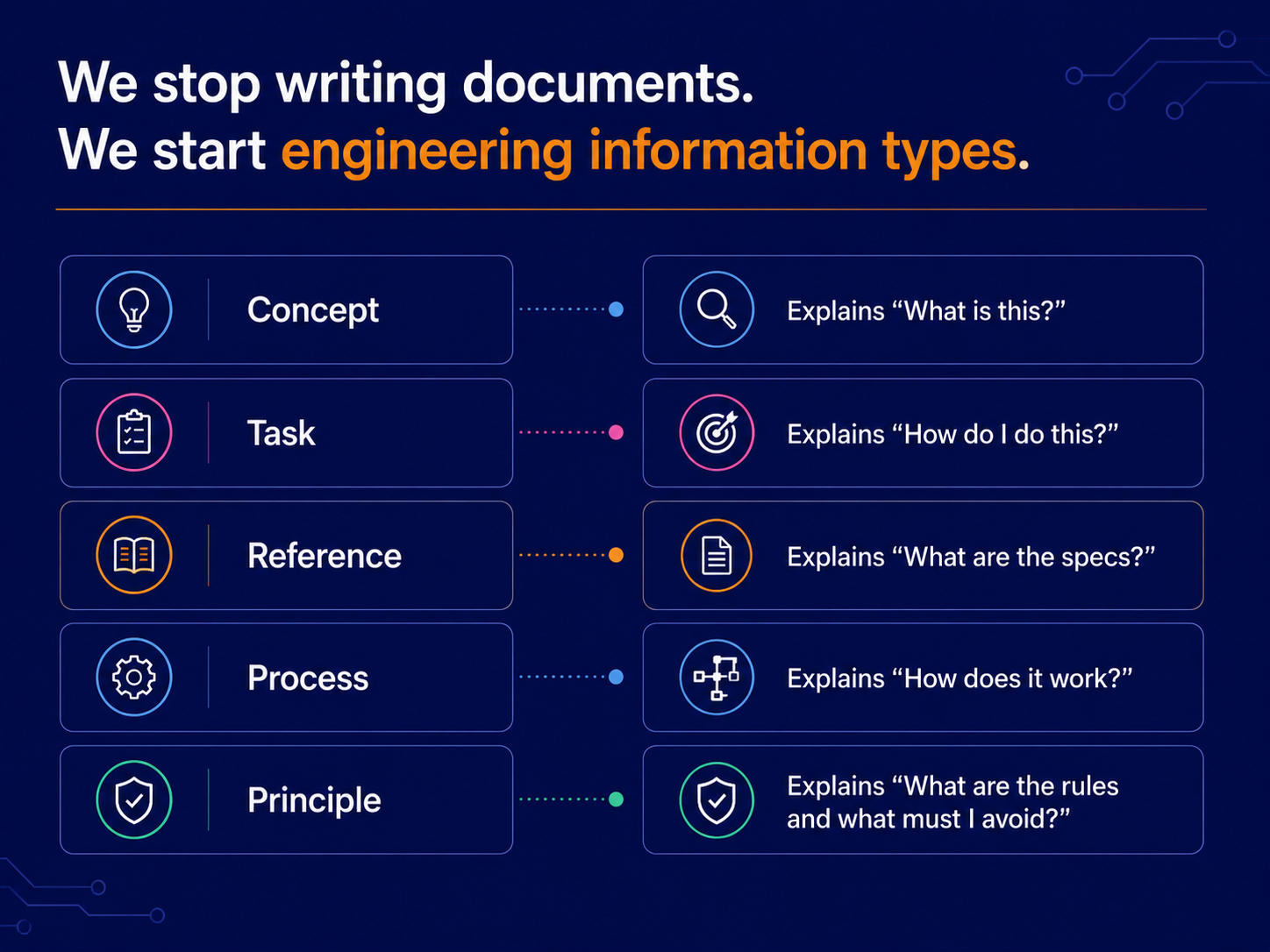
When content teams mix those intents without discipline, they create confusion for readers and machines. A topic that blends conceptual explanation, procedural steps, reference data, and business rules may still be understandable to an experienced human. But AI systems do not reliably infer missing context the way people do.
Rob explained that the purpose of information typing is to reduce cognitive load and improve precision. When organizations do not separate information by intent or purpose, content becomes harder to navigate and understand. With machine readers, he warned, some of that content may become “impenetrable.”
Structure is more than XML
One of the strongest moments in the discussion came when Rob clarified a common misconception. Structured content is not created simply by moving documentation into DITA, XML, or a CCMS. True structure comes from repeatable patterns that communicate meaning:
“Structure is not XML. Structure is repeated patterns and language that convey meaning.”
Rob Hanna
His point was that structured content is not created simply by moving documentation into DITA, XML, or a CCMS. True structure comes from repeated patterns of language and organization that convey meaning. XML can make those patterns easier to enforce, but it cannot replace disciplined content design.
Patrick Bosek reinforced the point by connecting structure to business outcomes. As he explained, the goal is to “enforce the patterns that work for your business outcomes” and create the consistency needed to do something valuable with the content later.
That distinction matters. A document can be technically valid and still be functionally weak. If everything is tagged as a concept because that is easier during migration, the structure no longer tells the truth about the content. The system may validate the markup, but the content still fails to communicate intent.
Patrick Bosek expanded the point by connecting structure to metadata. His definition was refreshingly clear:
“In my view, metadata is any information that isn’t the actual text.”
Patrick Bosek
AI is another delivery channel
The webinar also reframed AI as another content delivery channel. Organizations would never assume that raw DITA should be delivered directly as a finished PDF, website, or in-app experience. Each channel requires transformation.
AI is no different.
Rob argued that teams need to think carefully about how they feed content to AI systems. The same structures that work in XML may need to be transformed into something more digestible for AI, with metadata and inferred semantic meaning made explicit. Patrick extended that idea by pointing out that AI should be treated like any other channel that needs optimized input to produce the best output.
This is a critical shift. AI readiness is not about dumping a corpus into a model and hoping it finds the right answer. It is about engineering the content, metadata, classification, and context so the system can retrieve and use the right information.
Classification improves the “R” in RAG
Patrick made one of the clearest business cases for content classification when he connected it directly to retrieval-augmented generation.
“The reason you categorize and type things is because of the R in RAG. It’s the retrieval piece.”
Patrick Bosek
He explained that organizations cannot retrieve enterprise content effectively at scale if they rely only on pure vector search or keyword search. They need classification to improve both vector results and traditional search results.
His summary was simple and powerful:
“We improve the ‘R.’ That’s why we classify, so you can have better retrieval.”
Patrick Bosek
This reframes classification as a business-critical AI control, not a documentation preference. Better classification improves retrieval precision. Better retrieval reduces ambiguity. Reduced ambiguity improves the odds that AI systems generate accurate, trustworthy answers.
Prompt engineering cannot compensate for weak content
The group also challenged the belief that better prompts can overcome poor source material.
Prompting has value, especially for research, planning, and authoring support. But for content delivery, Rob emphasized that the content itself must contain the right information. It must also be disambiguated by product, version, locale, release, audience, and context.
If the correct answer is missing, buried, ambiguous, or contradicted elsewhere in the corpus, a prompt cannot reliably solve the problem. The system needs trusted content and the right surrounding context.
That is why the conversation is shifting from prompt engineering to context engineering. The future of AI-enabled documentation depends on how well organizations package the content and context that AI systems need.
Content standards are a governance shield
Another practical takeaway was the role of content standards. Rob argued that organizations often have style guides, but not comprehensive content standards. A style guide may tell writers how to punctuate or title something. A content standard defines how content should be planned, structured, typed, labeled, reviewed, and governed.
Rob described content standards as a “shield” when documentation teams face pushback from subject matter experts or product owners. Instead of treating classification and structure as personal preferences, teams can point to approved standards that define how content works across the organization.
That governance layer becomes even more important in AI-enabled environments. Standards help control risk, improve consistency, and reduce the likelihood that AI systems will misinterpret ambiguous content.
AI does not replace a CCMS
The webinar also addressed a question many organizations are asking: can AI help avoid the cost of a CCMS?
Rob’s answer focused on the content. Even without a CCMS, teams can start improving writing quality, chunking, titling, information typing, and standards now. As he put it:
“Content first, technology second.”
Rob Hanna
Patrick took the economic angle. Using AI to compensate for unstructured content may look cheaper at first, but the costs show up quickly in token usage, validation, rework, support, and risk. A CCMS solves many deterministic content supply-chain problems. AI should be part of the toolchain, but it should not be used to replace systems that already handle governance, reuse, workflow, and publishing reliably.
Patrick’s warning was direct:
“AI feels less expensive for a few months, but you find pretty quickly that it’s not.”
Patrick Bosek
The larger point is that unstructured content shifts cost downstream. Teams pay later through manual validation, model tuning, rework, support escalations, and reduced trust. Structured content shifts cost upstream, where it can be governed and controlled.
The Economics of AI: Bad Content Increases the Cost of Every Answer
Patrick Bosek offered one of the webinar’s clearest executive arguments: using AI to compensate for unstructured content may look cheaper at first, but the economics change quickly.
“AI token usage is a real thing. Every organization is starting to realize that it hits the bottom line in a very, very real way.”
Patrick Bosek
That matters because every unnecessary piece of content added to an AI context window increases cost. When organizations “throw everything into AI” and hope the system can figure it out, they make the answer more expensive and often less accurate. Patrick’s point was that better content structure allows organizations to give AI only the minimum context required to produce the right answer.
“Having a consistently smaller context window is a consistently less expensive AI solution.”
Patrick Bosek
This is the stronger takeaway for the blog. It is clear, practical, and directly tied to the value of structured content. Better content reduces the amount of material AI has to process. That improves accuracy, reduces ambiguity, and helps organizations get better return on every token they spend.
The bottom line: content is AI infrastructure
Perhaps the most important message from the webinar is that content must be treated as infrastructure. Patrick noted that AI is often a content engineering problem, because what differentiates one specialized AI experience from another is frequently the context provided to it. Rob put it even more directly:
“Content is your AI infrastructure.”
Rob Hanna
That idea should change how organizations think about documentation. Content is not just a publishing asset. It is not just support material. It is not a static repository of product facts.
In an AI-enabled enterprise, content is the ground truth that systems rely on to answer questions, guide users, support employees, reduce risk, and deliver trusted experiences.
The organizations that invest in consistent, structured, classified, governed, and trustworthy content will be better prepared for every AI channel that comes next. Those that ignore content quality will spend more time correcting AI output, managing risk, and explaining why the answers cannot be trusted.
AI readiness starts with content readiness. And content readiness starts with the discipline to make content clear, consistent, structured, and trustworthy before the machine ever sees it.
Thank You to Scott and Patrick
A sincere thank you to Scott Abel and Patrick Bosek for a thoughtful and practical discussion about what AI readiness really requires.

The conversation helped move the topic beyond tools and hype, and toward the deeper work of making content clear, consistent, structured, classified, governed, and trustworthy.
Watch the Full Webinar Recording
The full conversation is worth watching for any content, documentation, or knowledge management leader thinking about AI readiness. Rob Hanna, Scott Abel, and Patrick Bosek go beyond the hype and get practical about what organizations need to do now to make their content more reliable, retrievable, and useful for AI-enabled experiences.
The webinar explores why consistency, structure, metadata, classification, and governance are no longer just documentation concerns. They are the foundation for trusted AI outcomes.
You can watch the full recording here:
Watch the webinar and hear the full discussion.
Website: https://www.brighttalk.com/webcast/9273/665954
Note: A free BrightTALK account is required to access the recording.