
CAN/ASC-3.1:2025 · Plain Language Training
Turn Canada’s plain-language standard into everyday writing practice.
Precision Content® Writer Training gives government teams one shared methodology for creating information citizens can find, understand, and use.
Selected Canadian public-sector clients


From standard to practice
The standard sets the outcome. Training changes the behaviour.
CAN/ASC-3.1:2025 asks organizations to create communication their intended audience can successfully use. Templates and style guides alone do not tell writers how to organize complex information, control context, choose terminology, or structure instructions.
Your writers do not need another collection of tips. They need one method everyone can apply.
Why this matters
Clear government information is not cosmetic. It is access.
Nearly one in five Canadians aged 16 to 65 performs at Level 1 or below in literacy. They can work with short, explicit information, but comprehension becomes harder as information, decisions, and processes become more complex.
For government, complexity can become a barrier between a citizen and the service they need.
19%
of Canadians aged 16–65 are at Level 1 or below in literacy.
Statistics Canada / OECD
Government research confirms the barrier.
Canadians report confusing steps, unclear instructions, fear of mistakes, difficult online services, and difficulty getting help when navigating government programs.
The consequences are practical.
When eligibility, instructions, forms, or next steps are difficult to understand, services become harder to access and government teams absorb more questions, mistakes, and support demand.
The opportunity
Remove complexity before it reaches the citizen.
Precision Content gives writers a repeatable method for deciding what information belongs, how it should be organized, and how complex information can be made easier to find, understand, and use.
See the methodology
Same information. Better structure. Better decisions.
The expertise does not change. The structure, hierarchy, content boundaries, and writing patterns do.
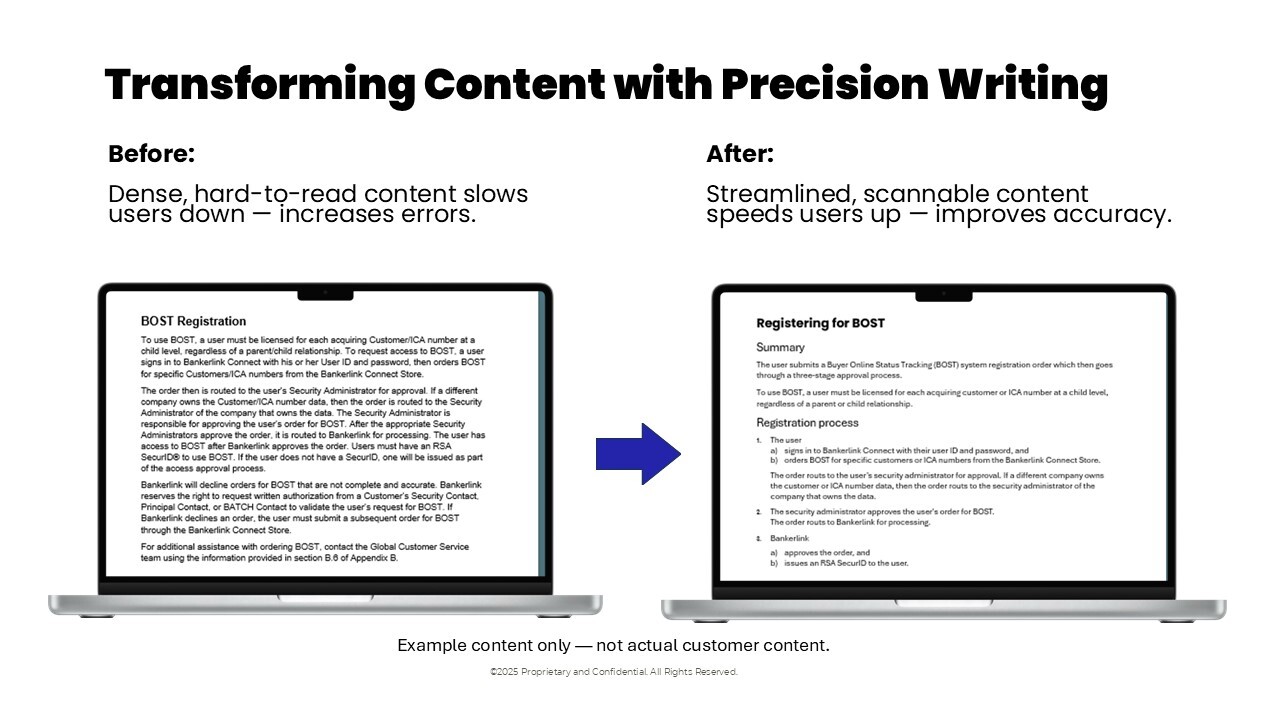
Dense information becomes easier to scan, navigate, understand, and reuse.
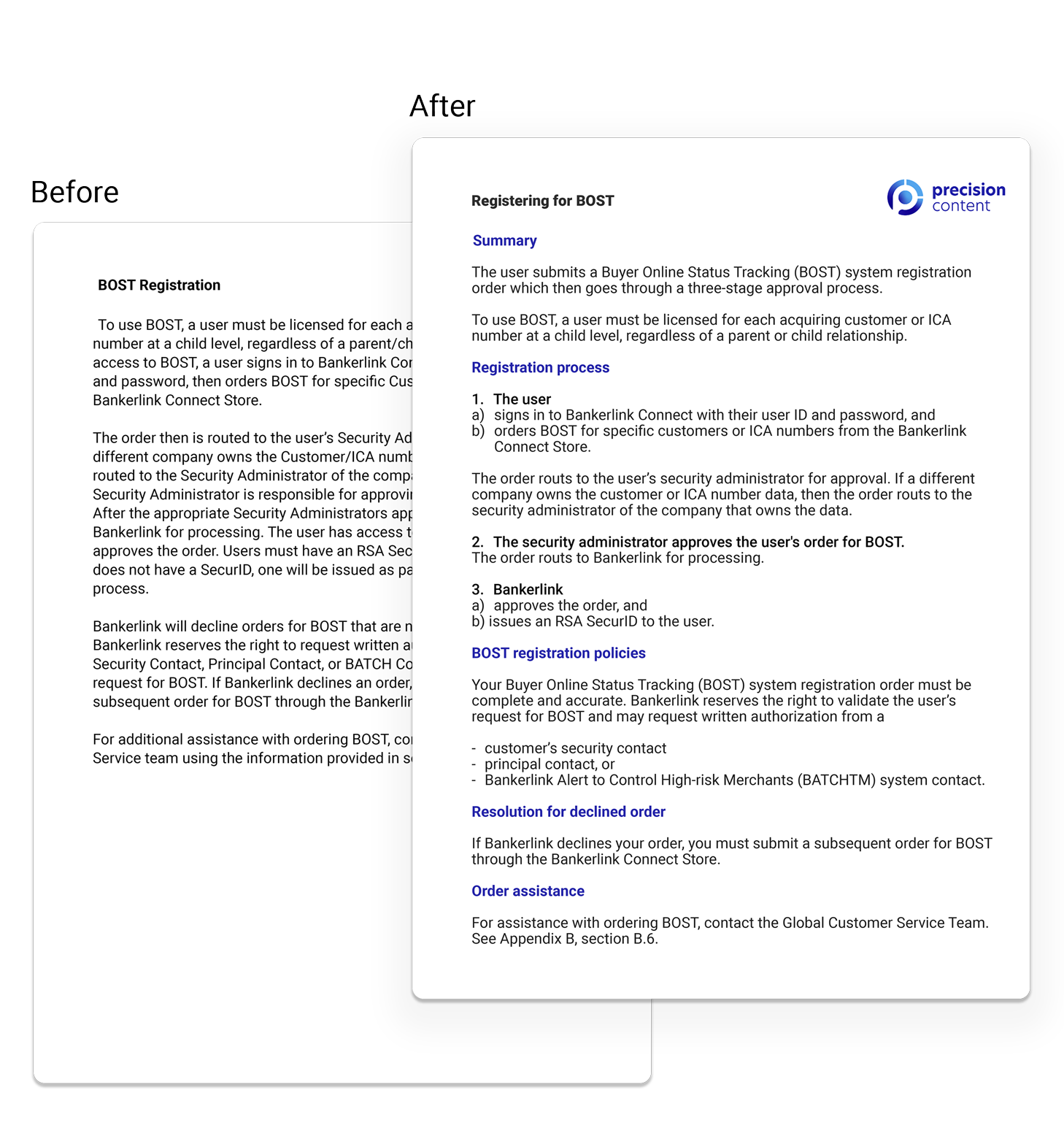
Writers stop solving every page differently and start applying a shared content standard.
Clearer for people. More consistent for the organization. Better structured for the systems that use it next.
Precision Content® Writer Training
Not theory. A methodology.
Writers learn a repeatable way to analyze information, classify it, structure it, and write it clearly across policies, procedures, guidance, web content, knowledge articles, and other complex government information.
01 · Learn
Build the foundation.
15 self-paced modules teach the Precision Content® Fundamentals and Methods.
02 · Apply
Practice it together.
Live instructor-led workshops move the methodology from knowledge to working skill.
03 · Reinforce
Make the standard stick.
Support writers after training so the methodology becomes part of day-to-day work.
Build the capability
Make plain language a capability, not a campaign.
Start with your team and your content. We’ll help you build a shared writing method that supports clearer communication and adoption of CAN/ASC-3.1:2025.
CAN/ASC-3.1:2025 is a voluntary National Standard of Canada. Precision Content training supports plain-language authoring capability and alignment with relevant requirements. Training alone does not establish conformity with the complete standard.