

more correct answers
18% before → 64% after
fewer wrong answers
38% before → 8% after
faster time-to-answer
125 sec before → 70 sec after
points in user confidence
6.3 before → 8.9 after
Controlled usability study with 30 participants completing the same tasks before and after the content transformation.
Executive Summary
The platform was in place. The content was holding performance back.
Mastercard relied on technical and support content to help users find accurate answers and complete important tasks. But the content had become inconsistent, difficult to navigate, and harder to trust.
Precision Content introduced a shared content standard, redesigned the information architecture, strengthened terminology and quality controls, and enabled Mastercard’s team to sustain the change.
The Challenge
Technology could manage the content. It could not fix what was embedded inside it.
What users experienced
Too much friction between the question and the answer.
• Answers were difficult to locate
• Structures and terminology varied
• Important facts were buried in dense content
• Users were less confident in what they found
The underlying constraint
The CCMS investment was limited by the quality of the source.
• No shared, enforceable content standard
• Architecture did not reflect user intent
• Quality varied from writer to writer
• Governance could not operate consistently at scale

The Transformation
We changed the content system, not just the wording.
Precision Content combined content strategy, information architecture, authoring standards, quality controls, and team enablement.
Set the standard
Shared patterns for clearer, more explicit content.
Redesign the architecture
Information organized around user intent and reuse.
Govern the language
Consistent terminology and taxonomy reduced ambiguity.
Improve findability
Content and search aligned around real questions.
Automate quality
Acrolinx reinforced clarity, style, and consistency.
Build capability
Writers and trainers learned to sustain the standard.
The Evidence
The content became easier for people to use and easier for systems to work with.
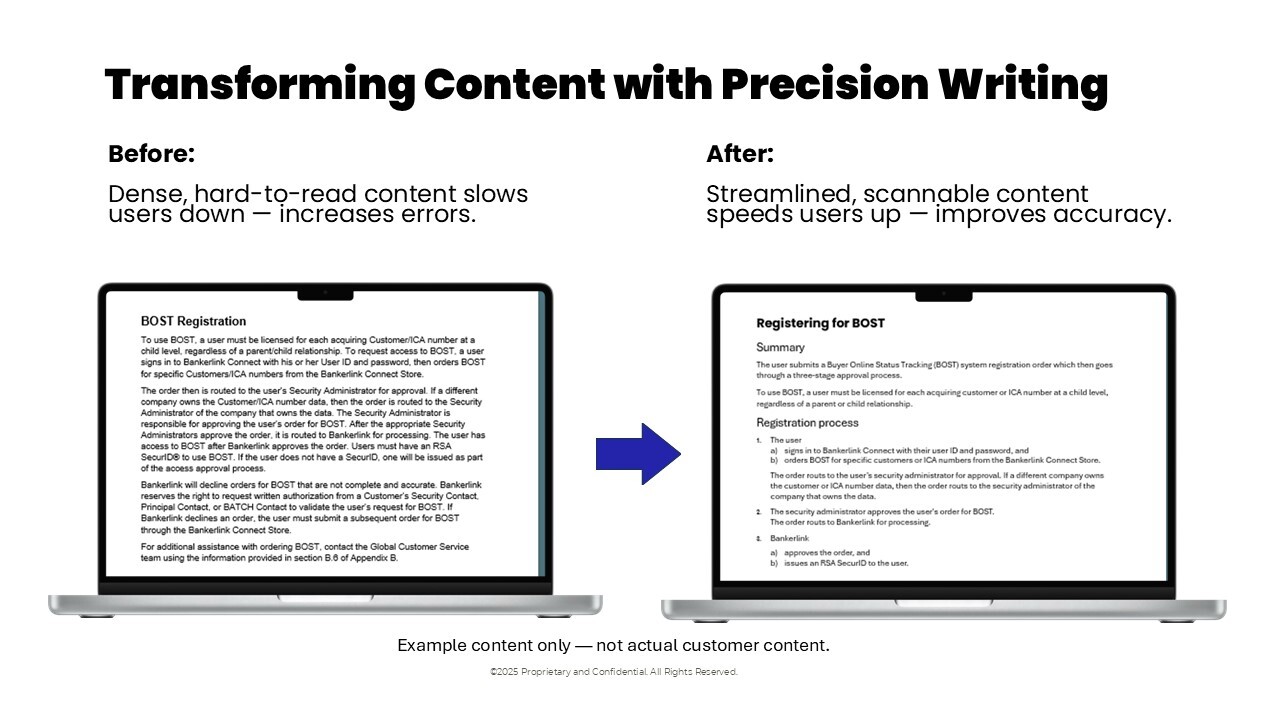
Dense, context-dependent material became clear, structured components with predictable patterns and explicit meaning.
The CCMS could finally do more because the knowledge inside it had been designed to perform.
The Strategic Value
Mastercard created a stronger knowledge foundation.
Intent became explicit
Content was organized around what users needed to understand, decide, find, and do.
Knowledge became modular
Rules, procedures, and references became easier to retrieve, reuse, and maintain.
Ground truth became governable
Clearer meaning, stronger context, and better controls created a more reliable foundation for automation and AI.