
The bank had the information. The problem was turning it into usable knowledge.
Employees depended on lengthy operational procedures to support clients and make decisions, but critical information was often buried in inconsistent structures and difficult-to-navigate content.
That created a hidden cost: slower answers, more opportunity for error, lower confidence, and greater dependence on colleagues and experience.
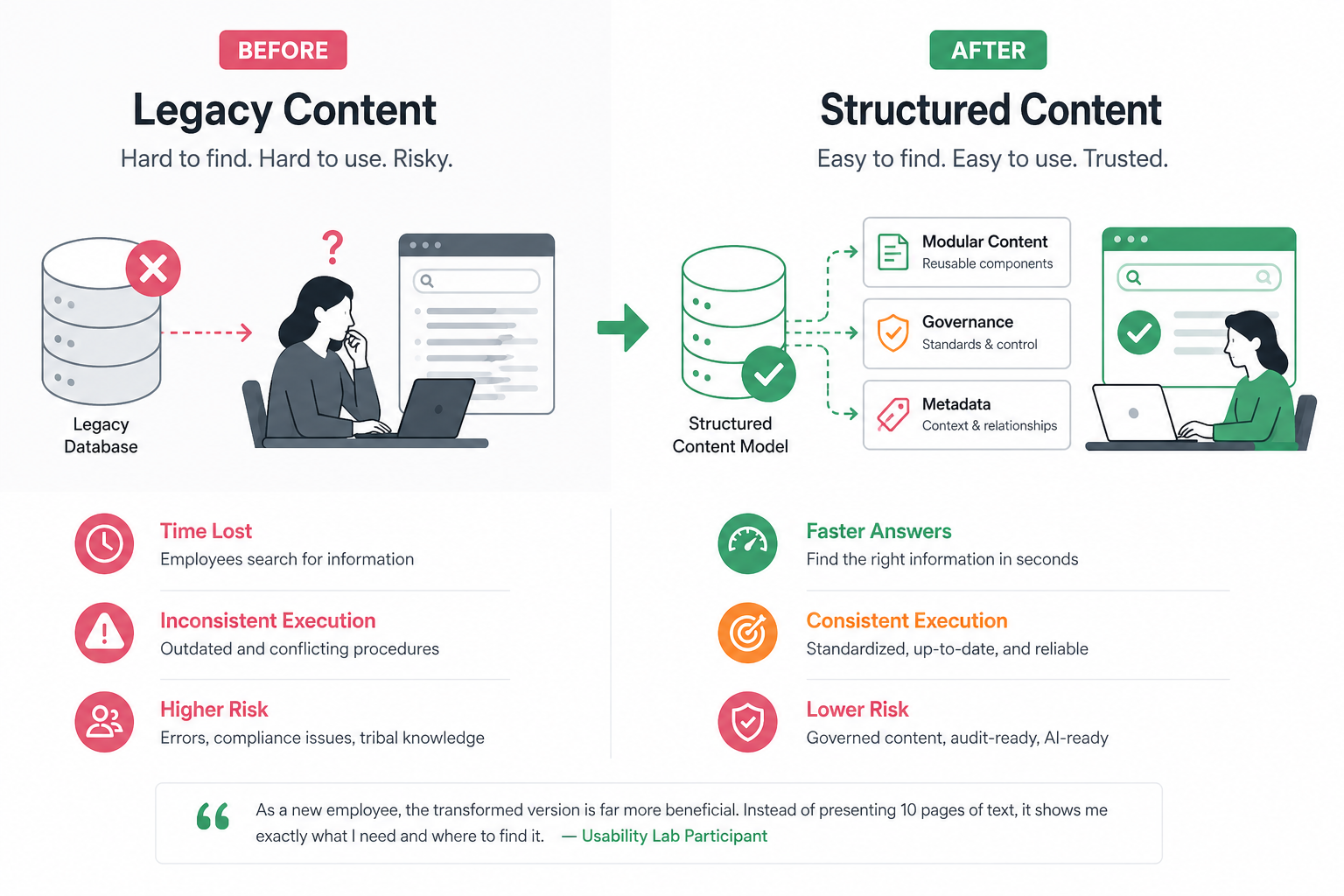
Precision Content changed the content operating model, not just the wording.
We analyzed the existing procedures, redesigned the information structure around user intent, applied a shared authoring methodology, and helped the internal team sustain the model.
Better content changed user performance.
We tested existing procedures against procedures transformed using the Precision Content methodology. We measured time to answer, accuracy, and confidence.
Participants specifically attributed the improvement to clearer navigation, descriptive titles, and better-organized information.
“It’s the same information? You’ve got to be kidding me. It’s not even comparable. The second one is much faster.”
Usability Study Participant
Global Fortune 100 Financial Institution
Structured content moved from operational improvement to strategic infrastructure.
Global Fortune 100 Bank
The usability study measured human performance, not AI performance.
But the same content characteristics that improved human performance are now critical to enterprise AI.
Explicit intent
So systems can distinguish what information means and when it applies.
Predictable structure
So knowledge can be retrieved and interpreted more reliably.
Modular content
So information can be reused and assembled without dragging unnecessary context with it.
Governed source knowledge
So people and AI are working from controlled, current, traceable information.
A stronger knowledge layer for both people and AI.
The institution did not simply create better procedures. It created a more scalable, governable, reusable, and trustworthy foundation for enterprise knowledge.
“Precision Content helped us rethink how we manage knowledge. They provided a strong foundation through their content audit, strategy, and writing methodology, and helped us upskill our team to create scalable, user-friendly, AI-ready documentation. Our users are finding the right answers faster and supporting our clients with more confidence.”
Vice President, Client Onboarding and Service
Global Fortune 100 Bank
Better answers start with better source knowledge.
AI does not create enterprise truth. It works with the knowledge you give it.
Structured content makes that knowledge easier to govern, retrieve, reuse, and trust.